
Data Analyst vs Web Developer Salary: You just finished your degree, browsed 50 job listings, and now you are stuck between two paths — Data Analyst or Web Developer. Both look good on paper. Both are in demand. But which one actually pays better for freshers in India in 2026, and which one is easier to break into? Let us cut through the noise and give you a real comparison.
The Big Picture — What Do These Roles Actually Do?
Before jumping to salary numbers, you need to understand what each job asks of you daily. A Data Analyst spends their time collecting raw data, cleaning it, running queries using tools like SQL and Python, and turning numbers into business insights. Think of it as being the detective of a company — you spot patterns that others miss.
A Web Developer builds and maintains websites or web applications. Depending on your stack, you could be designing what users see (frontend), handling databases and servers (backend), or doing both (full stack). You are essentially the builder of the digital world.
Fresher Salary in India 2026 — The Real Numbers
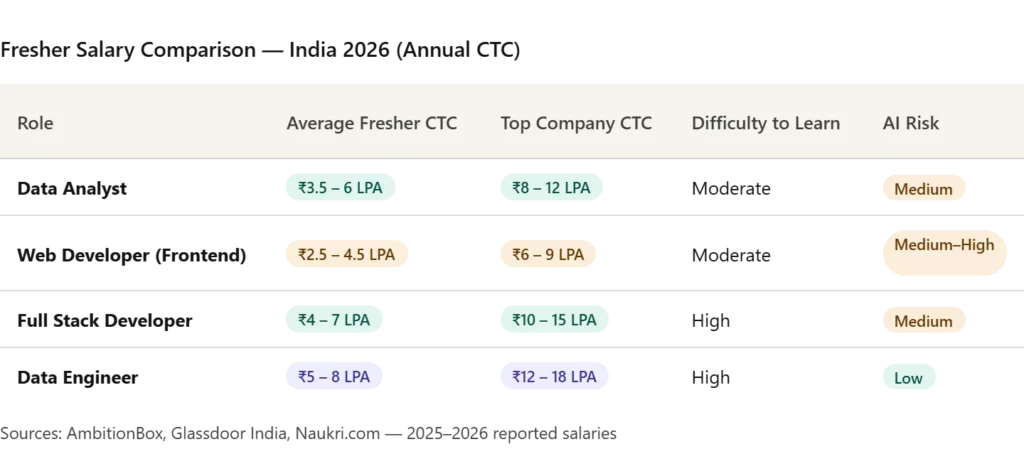
The honest answer is that both roles have similar starting points for freshers, but Data Analysts in product companies and startups tend to pull ahead faster after 1 to 2 years due to high demand for SQL, Python, and Tableau skills.
Who Earns More in 2026 — Web Developer or Data Analyst?
For freshers entering the market right now, the answer is not black and white.
A junior Web Developer at a service company like TCS, Infosys, or Wipro often starts at ₹3 to 4 LPA. A fresher Data Analyst at a product startup or analytics firm can land ₹4 to 6 LPA in their first role. The gap exists because data skills are still relatively scarce compared to the sheer volume of web developers graduating every year.
However, a Full Stack Developer who knows both React and Node.js comfortably earns just as much as a mid-level Data Analyst. It really depends on your company type.
Which is Easier to Learn — Web Development or Data Analytics?
This is one of the most searched questions, and here is the honest take. Web Development has a lower barrier to entry in the beginning. You can build a visible,
working website within weeks using HTML, CSS, and JavaScript. The feedback is instant and satisfying. However, as you go deeper into frameworks like React, backend systems, databases, and DevOps, it gets significantly harder.
Data Analytics starts slow. The first month is mostly understanding statistics, SQL queries, and Python basics without seeing a “product” you can show friends. But once you get past that curve, it becomes very logical and pattern-driven. If you enjoy solving puzzles with numbers, this path starts to feel natural very quickly.
Both can be learned in 3 to 6 months at a fundamental level. But being job-ready is a different story — that typically takes 6 to 9 months of consistent practice, building projects, and contributing to real datasets or codebases.
Can You Learn Either in 3 Months?
Yes, but only the fundamentals. For Data Analytics in 3 months, a realistic roadmap looks like this. Week 1 to 3 covers Excel and basic statistics. Week 4 to 8 covers SQL and data cleaning. Week 9 to 12 covers Python with Pandas and simple Tableau or Power BI dashboards.
For Web Development in 3 months, the roadmap looks like this. Week 1 to 3 covers HTML and CSS. Week 4 to 6 covers JavaScript fundamentals. Week 7 to 12 covers a frontend framework like React and one backend project.
At the end of 3 months, you will be a beginner. But you will have enough to apply for internships and junior roles.
Will AI Replace Data Analysts and Web Developers?
This is the question keeping freshers up at night in 2026, and it deserves a straight answer.
AI is already automating parts of both roles. Tools like GitHub Copilot and v0 by Vercel can generate frontend code in seconds. Automated dashboards and AI-powered analytics platforms are handling basic reporting tasks.
But here is what AI cannot do yet. It cannot understand your specific business context. It cannot ask the right question when data looks wrong. It cannot make judgment calls about what a stakeholder actually needs versus what they said they need. These are deeply human skills.
Web developers who only copy-paste templates are at higher risk. Data analysts who only run the same reports every week are at higher risk. But professionals who understand systems,
can debug complex problems, and can translate data or code into business value are very safe. The advice for 2026 freshers is simple. Do not just learn the tool. Learn the thinking behind the tool.
Data Analyst vs Data Engineer — Should You Choose One Over the Other?
Many freshers confuse these two roles. A Data Analyst interprets and visualizes data to help decisions. A Data Engineer builds the pipes and systems that move and store data in the first place.
Data Engineers generally earn more starting from mid-career (₹5 to 8 LPA at fresher level) and their role is far less replaceable by AI in the near future. If you enjoy backend systems, cloud infrastructure, and enjoy writing Python scripts that process millions of rows automatically, Data Engineering is worth considering.
That said, starting as a Data Analyst and transitioning to Data Engineering after 1 to 2 years is a very common and smart path.
Java Full Stack vs Data Analytics — Which is Better in 2026?
Java Full Stack is a strong choice if you want to work in large enterprises, banking tech firms, or product companies that rely on robust backend systems. The salary ceiling is high and there is always demand.
Data Analytics is better if you want to work in fast-growing startups, consulting firms, or any business that is data-driven (which in 2026 is almost every company).
If you are purely looking at which one will make you stand out at interviews faster, Data Analytics with Python and SQL skills tends to get callbacks quicker in the current market — primarily because fewer fresh graduates are comfortable with data than with writing Java code.
The 4 Types of Data Analysts You Should Know About
Not all Data Analyst roles are the same. Understanding these types helps you aim for the right job.
A Descriptive Analyst focuses on what happened — they look at historical data and build reports. A Diagnostic Analyst focuses on why it happened — they dig deeper into anomalies and root causes. A Predictive Analyst uses models and machine learning to forecast what will happen next. A Prescriptive Analyst recommends what action to take based on that forecast.
Freshers almost always start in the descriptive category. The goal is to move toward predictive work over time — that is where the real salaries begin.
What are L1, L2, L3, and L4 Developer Levels?
If you have seen these terms in job descriptions and wondered what they mean, here is a quick breakdown.
L1 is a junior developer handling basic tasks under supervision. L2 is a mid-level developer who works independently on features. L3 is a senior developer who owns modules and mentors others. L4 is a staff or principal engineer who influences technical direction across teams.
Most freshers start at L1. Getting from L1 to L2 typically takes 1 to 2 years of focused work. This ladder exists in data roles as well, just with different names like Analyst I, Analyst II, and Senior Analyst.
Is 27 Too Late to Start Coding or Data Analytics?
Absolutely not. Many of the strongest developers and analysts in the industry switched careers in their late 20s or early 30s. What matters in 2026 is your portfolio, your ability to solve problems, and your communication skills.
Companies hiring freshers in India primarily look at your projects, your GitHub or Kaggle profile, and how you explain your thinking in interviews. Age barely factors in for technical roles at this level.
If you are 27 and starting now, you actually have an advantage over a 21-year-old. You understand how businesses work. You ask better questions. You have more real-world context to apply your skills to.
Which Should YOU Choose in 2026?
Here is a simple guide based on what kind of person you are.
Choose Data Analytics if you enjoy math, patterns, and working with business stakeholders. You are comfortable with ambiguity and love asking “why.” You want to work in industries like finance, healthcare, e-commerce, or consulting.
Choose Web Development if you love building things people can see and use. You enjoy design and logic equally. You want to freelance or work at a product company. Full stack is the stronger bet over pure frontend if you can manage the learning curve.
Choose Data Engineering if you enjoy systems, automation, and backend pipelines. This is the highest paid of the three over a 3 to 5 year horizon.
Final Word — Which Pays More Long Term?
In the short term, both roles are comparable for freshers. Over 3 to 5 years, a skilled Data Engineer or a senior Full Stack Developer both approach the ₹20 to 30 LPA range at good companies. A sharp Data Scientist who started as an Analyst can reach ₹1 crore CTC at FAANG companies, but that requires advanced machine learning skills and typically a top-tier college background or exceptional portfolio.
The real answer is not which field pays more. It is which field you will actually put in the hours to get good at. Passion beats salary expectations every single time in the long run.
Which path are you leaning toward — Data Analytics or Web Development? Drop your thoughts in the comments below. If this helped you make a decision, share it with a friend who is stuck at the same crossroads. And if you want a detailed roadmap for either path, check out our career guides for freshers.